


- ONET2804TY - 集成电路(IC) > 线性 > 放大器 > 特殊用途放大器
- BOOSTXL-OV788ADAPT - 开发板,套件,编程器 > 评估板 > 扩展板,子卡
- LM3814M-7.0/NOPB - 集成电路(IC) > 电源管理(PMIC) > 电流调节/管理
- CD74HC123NSR - 集成电路(IC) > 逻辑 > 多谐振荡器
- LP2983IM5X-1.2 - 集成电路(IC) > 电源管理(PMIC) > 稳压器 - 线性
- LM2676SX-ADJ/NOPB - 集成电路(IC) > 电源管理(PMIC) > 稳压器 - DC-DC 开关稳压器
- LP2950CDTX-3.0 - 集成电路(IC) > 电源管理(PMIC) > 稳压器 - 线性
- LM4041C12QDBZR - 集成电路(IC) > 电源管理(PMIC) > 电压基准
- CDCU877RTBT - 集成电路(IC) > 时钟/定时 > 应用特定时钟/定时
- OPA846IDBVR - 集成电路(IC) > 线性 > 放大器 > 仪器,运算放大器,缓冲器
- LMR51603XDBVR - 集成电路(IC) > 电源管理(PMIC) > 稳压器 - DC-DC 开关稳压器
- TPS65266RHBR - 集成电路(IC) > 电源管理(PMIC) > 稳压器 - DC-DC 开关稳压器
- UCC2803D - 集成电路(IC) > 电源管理(PMIC) > DC-DC 开关控制器
- LP3925RME-E/NOPB - 集成电路(IC) > 电源管理(PMIC) > 电源管理 - 专用
- CD4068BEG4 - 集成电路(IC) > 逻辑 > 门和反相器 - 多功能,可配置
- DRV8935PRGER - 集成电路(IC) > 电源管理(PMIC) > 全半桥驱动器
- LM21305DEMO/NOPB - 评估板 - DC-DC 与 AC-DC(离线)SMPS
- BQ24161BYFFR - 集成电路(IC) > 电源管理(PMIC) > 电池充电器
- LPC661IM - 集成电路(IC) > 线性 > 放大器 > 仪器,运算放大器,缓冲器
- MSP430F148IPMR - 集成电路(IC) > 嵌入式 > 微控制器


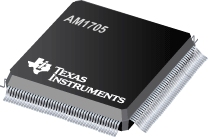
AM1705 - Sitara 处理器
AM1705是TI德州仪器公司的一款ARM9产品,AM1705是Sitara 处理器,本站介绍了AM1705的封装应用图解、特点和优点、功能等,并给出了与AM1705相关的TI元器件型号供参考。
AM1705 - Sitara 处理器 - ARM9 - Sitara处理器 - 德州仪器
- 375- and 456-MHz ARM926EJ-S™ RISC Core
- 32-Bit and 16-Bit (Thumb®) Instructions
- Single-Cycle MAC
- ARM Jazelle® Technology
- Embedded ICE-RT™ for Real-Time Debug
- ARM9™ Memory Architecture
- 16KB of Instruction Cache
- 16KB of Data Cache
- 8KB of RAM (Vector Table)
- 64KB of ROM
- Enhanced Direct Memory Access Controller 3 (EDMA3):
- 2 Transfer Controllers
- 32 Independent DMA Channels
- 8 Quick DMA Channels
- Programmable Transfer Burst Size
- 128KB of RAM Memory
- 3.3-V LVCMOS I/Os (Except for USB Interface)
- Two External Memory Interfaces:
- EMIFA
- NOR (8-Bit-Wide Data)
- NAND (8-Bit-Wide Data)
- EMIFB
- 16-Bit SDRAM with 128-MB Address Space
- EMIFA
- Three Configurable 16550-Type UART Modules:
- UART0 with Modem Control Signals
- 16-Byte FIFO
- 16x or 13x Oversampling Option
- Autoflow Control Signals (CTS, RTS) on UART0 Only
- Two Serial Peripheral Interfaces (SPIs) Each with One Chip Select
- Programmable Real-Time Unit Subsystem (PRUSS)
- Two Independent Programmable Real-Time Unit (PRU) Cores
- 32-Bit Load-Store RISC Architecture
- 4KB of Instruction RAM per Core
- 512 Bytes of Data RAM per Core
- PRUSS can be Disabled via Software to Save Power
- Standard Power-Management Mechanism
- Clock Gating
- Entire Subsystem Under a Single PSC Clock Gating Domain
- Dedicated Interrupt Controller
- Dedicated Switched Central Resource
- Two Independent Programmable Real-Time Unit (PRU) Cores
- Multimedia Card (MMC)/Secure Digital (SD) Card Interface with Secure Data I/O (SDIO)
- Two Master and Slave Inter-Integrated Circuit (I2C Bus™)
- USB 2.0 OTG Port with Integrated PHY (USB0)
- USB 2.0 Full-Speed Client
- USB 2.0 Full- and Low-Speed Host
- End Point 0 (Control)
- End Points 1,2,3,4 (Control, Bulk, Interrupt or ISOC) RX and TX
- Two Multichannel Audio Serial Ports (McASPs):
- Six Clock Zones and 28 Serial Data Pins
- Supports TDM, I2S, and Similar Formats
- FIFO Buffers for Transmit and Receive
- 10/100 Mbps Ethernet MAC (EMAC):
- IEEE 802.3 Compliant (3.3-V I/O Only)
- RMII Media-Independent Interface
- Management Data I/O (MDIO) Module
- One 64-Bit General-Purpose Timer (Configurable as Two 32-Bit Timers)
- One 64-Bit General-Purpose Watchdog Timer (Configurable as Two 32-Bit General-Purpose Timers)
- Three Enhanced Pulse Width Modulators (eHRPWMs):
- Dedicated 16-Bit Time-Base Counter with Period and Frequency Control
- 6 Single Edge, 6 Dual Edge Symmetric, or 3 Dual Edge Asymmetric Outputs
- Dead-Band Generation
- PWM Chopping by High-Frequency Carrier
- Trip Zone Input
- Three 32-Bit Enhanced Capture (eCAP) Modules:
- Configurable as 3 Capture Inputs or 3 Auxiliary Pulse Width Modulator (APWM) Outputs
- Single-Shot Capture of up to Four Event Time-Stamps
- Two 32-Bit Enhanced Quadrature Encoder Pulse (eQEP) Modules
- 176-pin PowerPAD™ Plastic Quad Flat Pack [PTP suffix], 0.5-mm Pin Pitch
- Commercial, Industrial, or Extended Temperature
- Industrial Automation
- Home Automation
- Test and Measurement
- Portable Data Terminals
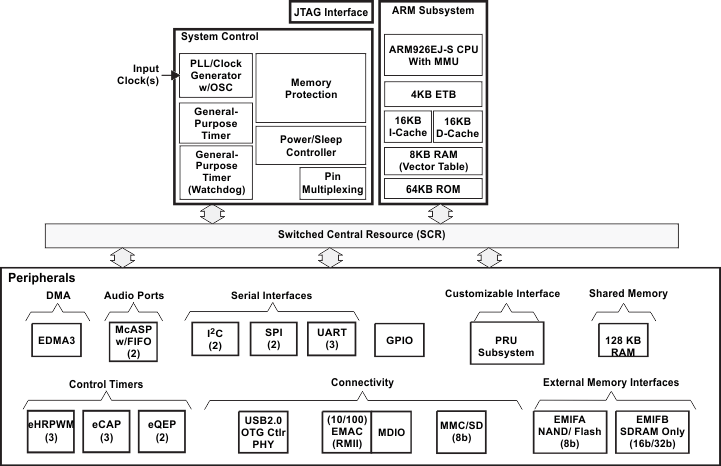
The device is a low-power ARM microprocessor based on an ARM926EJ-S.
The device enables original-equipment manufacturers (OEMs) and original-design manufacturers (ODMs) to quickly bring to market devices featuring robust operating systems support, rich user interfaces, and high processing performance life through the maximum flexibility of a fully integrated mixed processor solution.
The ARM926EJ-S is a 32-bit RISC processor core that performs 32-bit or 16-bit instructions and processes 32-bit, 16-bit, or 8-bit data. The core uses pipelining so that all parts of the processor and memory system can operate continuously.
The ARM core has a coprocessor 15 (CP15), protection module, and data and program memory management units (MMUs) with table look-aside buffers. The ARM core has separate 16KB of instruction and 16-KB data caches. Both memory blocks are four-way associative with virtual index virtual tag (VIVT). The ARM core also has 8KB of RAM (Vector Table) and 64KB of ROM.
The peripheral set includes: a 10/100 Mbps Ethernet MAC (EMAC) with a management data input/output (MDIO) module; two I2C Bus interfaces; 3 multichannel audio serial port (McASP) with serializers and FIFO buffers; two 64-bit general-purpose timers each configurable (one configurable as watchdog); up to 8 banks of 16 pins of general-purpose input/output (GPIO) with programmable interrupt/event generation modes, multiplexed with other peripherals; three UART interfaces (one with both RTS and CTS); three enhanced high-resolution pulse width modulator (eHRPWM) peripherals; three 32-bit enhanced capture (eCAP) module peripherals which can be configured as 3 capture inputs or 3 auxiliary pulse width modulator (APWM) outputs; two 32-bit enhanced quadrature encoded pulse (eQEP) peripherals; and 2 external memory interfaces: an asynchronous and SDRAM external memory interface (EMIFA) for slower memories or peripherals, and a higher speed memory interface (EMIFB) for SDRAM.
The Ethernet Media Access Controller (EMAC) provides an efficient interface between the device and the network. The EMAC supports both 10Base-T and 100Base-TX, or 10 Mbps and 100 Mbps in either half- or full-duplex mode. Additionally, an MDIO interface is available for PHY configuration.
The I2C, SPI, and USB2.0 ports allow the device to easily control peripheral devices and/or communicate with host processors.
The rich peripheral set provides the ability to control external peripheral devices and communicate with external processors. For details on each of the peripherals, see the related sections later in this document and the associated peripheral reference guides.
The device has a complete set of development tools for the ARM processor. These include C compilers and a Windows® debugger interface for visibility into source code execution.
| PART NUMBER | PACKAGE | BODY SIZE |
|---|---|---|
| AM1705 | HLQFP (176) | 24.00 mm x 24.00 mm |
- CD74AC253 - 具有三态输出的双路 4 输入多路复用器
- LP38691-Q1 - 借助陶瓷输出电容实现稳定的 500mA 低压降 CMOS 线性稳压器
- LM2854 - 4A 500 kHz / 1 MHz 同步 SIMPLE SWITCHER? 降压稳压器
- SN75LBC174 - 四路低功耗差动线路驱动器
- TRS3227E - 具有 +/-15-kV IEC ESD 保护的 3V 至 5.5V 单通道 RS-232 线路驱动器/接收器
- UCC3813-2 - 低功耗经济型 BiCMOS 电流模式 PWM
- TPS40193 - 具有电源状态良好指示的 4.5V 至 18V 输入、低引脚数同步降压控制器
- LM3205 - 用于射频功率放大器的 650mA 微型、可调节、降压 DC-DC 转换器
- SN74AUC2G86 - 双路 2 输入异或门
- MSP430FR5948 - Wolverine 混合信号微控制器

