


- SN74AS652DWRG4 - 集成电路(IC) > 逻辑 > 缓冲器,驱动器,接收器,收发器
- TLC556IN - 集成电路(IC) > 时钟/定时 > 可编程定时器和振荡器
- SN74AHC3G99PWR - 集成电路(IC) > 逻辑 > 门和反相器 - 多功能,可配置
- TPS76915DBVR - 集成电路(IC) > 电源管理(PMIC) > 稳压器 - 线性
- TPS60403QDBVRQ1 - 集成电路(IC) > 电源管理(PMIC) > 稳压器 - DC-DC 开关稳压器
- LM2597M-12/NOPB - 集成电路(IC) > 电源管理(PMIC) > 稳压器 - DC-DC 开关稳压器
- TPS9900TPZPQ1 - 集成电路(IC) > 电源管理(PMIC) > 电源管理 - 专用
- OPA2387DSGR - 集成电路(IC) > 线性 > 放大器 > 仪器,运算放大器,缓冲器
- LM336D-2-5 - 集成电路(IC) > 电源管理(PMIC) > 电压基准
- CD4010BMT - 集成电路(IC) > 逻辑 > 缓冲器,驱动器,接收器,收发器
- SN74LS112ADR - 集成电路(IC) > 逻辑 > 触发器
- TPS629210QDRLRQ1 - 集成电路(IC) > 电源管理(PMIC) > 稳压器 - DC-DC 开关稳压器
- TCAN1146DYYRQ1 - 集成电路(IC) > 接口 > 驱动器,接收器,收发器
- CD74HCT356M96G4 - 逻辑 - 信号开关,多路复用器,解码器
- TCA6424ARGJR - 集成电路(IC) > 接口 > I/O 扩展器
- UC3875DWPTR - 集成电路(IC) > 电源管理(PMIC) > AC DC 转换器,离线开关
- PT3343A - 板安装电源 > 直流转换器
- THS4052CDGN - 集成电路(IC) > 线性 > 放大器 > 仪器,运算放大器,缓冲器
- TL084IDRG4 - 集成电路(IC) > 线性 > 放大器 > 仪器,运算放大器,缓冲器
- 74AVCBH324245ZKER - 集成电路(IC) > 逻辑 > 转换器,电平移位器


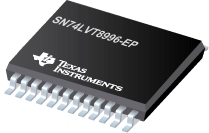
SN74LVT8996-EP - 增强型产品 3.3V Abt 10 位多点可寻址 Ieee Std 1149.1 Tap 收发器
SN74LVT8996-EP是TI德州仪器公司的一款边界扫描(JTAG)逻辑产品,SN74LVT8996-EP是增强型产品 3.3V Abt 10 位多点可寻址 Ieee Std 1149.1 Tap 收发器,本站介绍了SN74LVT8996-EP的封装应用图解、特点和优点、功能等,并给出了与SN74LVT8996-EP相关的TI元器件型号供参考。
SN74LVT8996-EP - 增强型产品 3.3V Abt 10 位多点可寻址 Ieee Std 1149.1 Tap 收发器 - 边界扫描(JTAG)逻辑 - 特殊逻辑 - 德州仪器
The SN74LVT8996 10-bit addressable scan port (ASP) is a member of the Texas Instruments SCOPE™ testability integrated-circuit family. This family of devices supports IEEE Std 1149.1-1990 boundary scan to facilitate testing of complex circuit assemblies. Unlike most SCOPE™ devices, the ASP is not a boundary-scannable device, rather, it applies TI’s addressable-shadow-port technology to the IEEE Std 1149.1-1990 (JTAG) test access port (TAP) to extend scan access beyond the board level.
This device is functionally equivalent to the ’ABT8996 ASPs. Additionally, it is designed specifically for low-voltage (3.3-V) VCC operation, but with the capability to interface to 5-V masters and/or targets.
Conceptually, the ASP is a simple switch that can be used to directly connect a set of multidrop primary TAP signals to a set of secondary TAP signals - for example, to interface backplane TAP signals to a board-level TAP. The ASP provides all signal buffering that might be required at these two interfaces. When primary and secondary TAPs are connected, only a moderate propagation delay is introduced - no storage/retiming elements are inserted. This minimizes the need for reformatting board-level test vectors for in-system use.
Most operations of the ASP are synchronous to the primary test clock (PTCK) input. PTCK is always buffered directly onto the secondary test clock (STCK) output.
Upon power up of the device, the ASP assumes a condition in which the primary TAP is disconnected from the secondary TAP (unless the bypass signal is used, as below). This reset condition also can be entered by the assertion of the primary test reset (PTRST)\ input or by use of shadow protocol. PTRST\ is always buffered directly onto the secondary test reset (STRST)\ output, ensuring that the ASP and its associated secondary TAP can be reset simultaneously.
When connected, the primary test data input (PTDI) and primary test mode select (PTMS) input are buffered onto the secondary test data output (STDO) and secondary test mode select (STMS) output, respectively, while the secondary test data input (STDI) is buffered onto the primary test data output (PTDO). When disconnected, STDO is at high impedance, while PTDO is at high impedance, except during acknowledgment of a shadow protocol. Upon disconnect of the secondary TAP, STMS holds its last low or high level, allowing the secondary TAP to be held in its last stable state. Upon reset of the ASP, STMS is high, allowing the secondary TAP to be synchronously reset to the Test-Logic-Reset state.
In system, primary-to-secondary connection is based on shadow protocols that are received and acknowledged on PTDI and PTDO, respectively. These protocols can occur in any of the stable TAP states other than Shift-DR or Shift-IR (i.e., Test-Logic-Reset, Run-Test/Idle, Pause-DR or Pause-IR). The essential nature of the protocols is to receive/transmit an address via a serial bit-pair signaling scheme. When an address is received serially at PTDI that matches that at the parallel address inputs (A9-A0), the ASP serially retransmits its address at PTDO as an acknowledgment and then assumes the connected (ON) status, as above. If the received address does not match that at the address inputs, the ASP immediately assumes the disconnected (OFF) status without acknowledgment.
The ASP also supports three dedicated addresses that can be received globally (that is, to which all ASPs respond) during shadow protocols. Receipt of the dedicated disconnect address (DSA) causes the ASP to disconnect in the same fashion as a nonmatching address. Reservation of this address for global use ensures that at least one address is available to disconnect all receiving ASPs. The DSA is especially useful when the secondary TAPs of multiple ASPs are to be left in different stable states. Receipt of the reset address (RSA) causes the ASP to assume the reset condition, as above. Receipt of the test-synchronization address (TSA) causes the ASP to assume a connect status (MULTICAST) in which PTDO is at high impedance but the connections from PTMS to STMS and PTDI to STDO are maintained to allow simultaneous operation of the secondary TAPs of multiple ASPs. This is useful for multicast TAP-state movement, simultaneous test operation (such as in Run-Test/Idle state), and scanning of common test data into multiple like scan chains. The TSA is valid only when received in the Pause-DR or Pause-IR TAP states.
Alternatively, primary-to-secondary connection can be selected by assertion of a low level at the bypass (BYP)\ input. This operation is asynchronous to PTCK and is independent of PTRST\ and/or power-up reset. This bypassing feature is especially useful in the board-test environment, since it allows the board-level automated test equipment (ATE) to treat the ASP as a simple transceiver. When the BYP\ input is high, the ASP is free to respond to shadow protocols. Otherwise, when BYP is low, shadow protocols are ignored.
Whether the connected status is achieved by use of shadow protocol or by use of BYP\, this status is indicated by a low level at the connect (CON)\ output. Likewise, when the secondary TAP is disconnected from the primary TAP, the CON\ output is high.
- Controlled Baseline
- One Assembly/Test Site, One Fabrication Site
- Enhanced Diminishing Manufacturing Sources (DMS) Support
- Enhanced Product-Change Notification
- Qualification Pedigree
- Member of the Texas Instruments (TI) Broad Family of Testability Products Supporting IEEE Std 1149.1-1990 (JTAG) Test Access Port (TAP) and Boundary-Scan Architecture
- Extends Scan Access From Board Level to Higher Levels of System Integration
- Promotes Reuse of Lower-Level Chip/Board) Tests in System Environment
- While Powered at 3.3 V, Both the Primary and Secondary TAPs Are Fully 5-V Tolerant for Interfacing to 5-V and/or 3.3-V Masters and Targets
- Switch-Based Architecture Allows Direct Connect of Primary TAP to Secondary TAP
- Primary TAP Is Multidrop for Minimal Use of Backplane Wiring Channels
- Shadow Protocols Can Occur in Any of Test-Logic-Reset, Run-Test/Idle, Pause-DR, and Pause-IR TAP States to Provide for Board-to-Board Test and Built-In Self-Test
- Simple Addressing (Shadow) Protocol Is Received/Acknowledged on Primary TAP
- 10-Bit Address Space Provides for up to 1021 User-Specified Board Addresses
- Bypass (BYP)\ Pin Forces Primary-to-Secondary Connection Without Use of Shadow Protocols
- Connect (CON)\ Pin Provides Indication of Primary-to-Secondary Connection
- High-Drive Outputs (–32-mA IOH, 64-mA IOL) Support Backplane Interface at Primary and High Fanout at Secondary
- Latch-Up Performance Exceeds 100 mA Per JESD 78, Class II
- ESD Protection Exceeds JESD 22
- 2000-V Human-Body Model (A114-A)
- 200-V Machine Model (A115-A)
- 1000-V Charged-Device Model (C101)
Component qualification in accordance with JEDEC and industry standards to ensure reliable operation over an extended temperature range. This includes, but is not limited to, Highly Accelerated Stress Test (HAST) or biased 85/85, temperature cycle, autoclave or unbiased HAST, electromigration, bond intermetallic life, and mold compound life. Such qualification testing should not be viewed as justifying use of this component beyond specified performance and environmental limits. SCOPE is a trademark of Texas Instruments.
- LP2997 - DDR-II 终止稳压器
- PGA2320 - +/-15V 立体声音频音量控制
- THS1408M - 14 位、8MSPS ADC,具有单通道、差动输入、DSP/uP 接口、可编程增益放大器、内部 S&H
- LM2727 - 用于低输出电压的 N 通道 FET 同步降压稳压器控制器
- TLK1002A - 二路信号调节收发器
- MSP430F4793 - 16 位超低功耗微控制器,具有 60KB 闪存、2.5KB RAM、3 Σ-Δ ADC、LCD 驱动器
- ADC32J42 - ADC32J42 双通道 14 位 50 160 Msps 模数转换器
- CD74HC423 - 具有复位功能的高速 CMOS 逻辑双路可重触发单稳多频振荡器
- SN74CBTLV3257-EP - 增强型产品低压 4 位 2 选 1 FET 多路复用器/多路解复用器
- DAC7744 - 16 位四路电压输出数模转换器

