


- MSP430FR68791IPZ - 集成电路(IC) > 嵌入式 > 微控制器
- TPS74901DRCRM3 - 集成电路(IC) > 电源管理(PMIC) > 稳压器 - 线性
- OPA699IDG4 - 集成电路(IC) > 线性 > 放大器 > 仪器,运算放大器,缓冲器
- CD4089BEG4 - 集成电路(IC) > 逻辑 > 专用逻辑器件
- LM5018MR/NOPB - 集成电路(IC) > 电源管理(PMIC) > 稳压器 - DC-DC 开关稳压器
- TPS2375PWR - 集成电路(IC) > 电源管理(PMIC) > 以太网供电(PoE)控制器
- TPS72516KTTT - 集成电路(IC) > 电源管理(PMIC) > 稳压器 - 线性
- SN74LXC2T45DTMR - 集成电路(IC) > 逻辑 > 转换器,电平移位器
- OPA336N/250 - 集成电路(IC) > 线性 > 放大器 > 仪器,运算放大器,缓冲器
- TLK10002CTR - 集成电路(IC) > 接口 > 驱动器,接收器,收发器
- CD74AC157M - 集成电路(IC) > 逻辑 > 信号开关,多路复用器,解码器
- TMS320C25FNA - 集成电路(IC) > 嵌入式 > DSP(数字信号处理器)
- TPS543620EVM - 开发板,套件,编程器 > 评估板 > DC/DC 和 AC/DC(离线)SMPS 评估板
- LM2512ASMX/NOPB - 集成电路(IC) > 接口 > 串行器,解串器
- JM38510/30203BDA - 集成电路(IC) > 逻辑 > 门和反相器
- LM741CN/NOPB - 集成电路(IC) > 线性 > 放大器 > 仪器,运算放大器,缓冲器
- TLC2252AQDR - 集成电路(IC) > 线性 > 放大器 > 仪器,运算放大器,缓冲器
- TLC7705IPWG4 - 集成电路(IC) > 电源管理(PMIC) > 监控器
- TLC2254QPWRQ1 - 集成电路(IC) > 线性 > 放大器 > 仪器,运算放大器,缓冲器
- MSP430G2544IDA38 - 集成电路(IC) > 嵌入式 > 微控制器


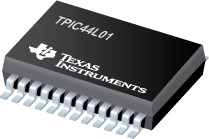
TPIC44L01 - 4 通道串联/并联低侧前置 FET 驱动器
TPIC44L01是TI德州仪器公司的一款由接口控制的前FET驱动器产品,TPIC44L01是4 通道串联/并联低侧前置 FET 驱动器,本站介绍了TPIC44L01的封装应用图解、特点和优点、功能等,并给出了与TPIC44L01相关的TI元器件型号供参考。
TPIC44L01 - 4 通道串联/并联低侧前置 FET 驱动器 - 由接口控制的前FET驱动器 - 电源管理特殊功能 - 德州仪器
The TPIC44L01, TPIC44L02, and TPIC44L03 are low-side predrivers that provide serial and parallel input interfaces to control four external FET power switches such as offered in the TI TPIC family of power arrays. These devices are designed primarily for low-frequency switching, inductive load applications such as solenoids and relays. Fault status for each channel is available in a serial-data format. Each driver channel has independent off-state open-load detection and on-state shorted-load/short-to-battery detection. Battery overvoltage and undervoltage detection and shutdown is provided on the TPIC44L01/L02. On the TPIC44L03 driver, only over-battery voltage shutdown is provided. Each channel also provides inductive-voltage-transient protection for the external FET.
These devices provide control of output channels through a serial input interface or a parallel input interface. A command to enable the output from either interface enables the respective channels gate output to the external FET. The serial interface is recommended when the number of signals between the control device and the predriver must be minimized and the speed of operation is not critical. In applications where the predriver must respond very quickly or asynchronously, the parallel input interface is recommended.
For serial operation, the control device must transition CS\ from high to low to activate the serial input interface. When this occurs, SDO is enabled, fault data is latched into the serial interface, and the fault flag is refreshed.
Data is clocked into the serial registers on low-to-high transitions of SCLK through SDI. Each string of data must consist of at least four bits of data. In applications where multiple devices are cascaded together, the string of data must consist of four bits for each device. A high data bit turns the respective output channel on and a low data bit turns it off. Fault data for the device is clocked out of SDO as serial input data is clocked into the device. Fault data consists of fault flags for shorted-load and open-load flags (bits 0\x963) for each of the four output channels. A high bit in the fault data indicates a fault and a low bit indicates that no fault is present for that channel. Fault register bits are set or cleared asynchronously to reflect the current state of the hardware. A fault must be present when CS\ is transitioned from high to low to be captured and reported in the serial fault data. New faults cannot be captured in the serial register when CS\ is low. CS\ must be transitioned high after all of the serial data has been clocked into the device. A low-to-high transition of CS\ transfers the last four bits of serial data to the output buffer puts SDO in a high-impedance state and clears and reenables the fault register. The TPIC44L01/L02/L03 was designed to allow the serial input interfaces of multiple devices to be cascaded together to simplify the serial interface to the controller. Serial input data flows through the device and is transferred out SDO following the fault data in cascaded configurations.
For parallel operation, data is transferred directly from the parallel input interface IN0-IN3 to the respective GATE(0\x963) output asynchronously. SCLK or CS\ is not required for parallel control. A 1 on the parallel input turns the respective channel on, where a 0 turns it off. Note that either the serial input interface or the parallel input interface can enable a channel. Under parallel operation, fault data must still be collected through the serial data interface.
The predrivers monitor the drain voltage for each channel to detect shorted-load or open-load fault conditions in the the on and off states respectively. These devices offer the option of using an internally generated fault-reference voltage or an externally supplied fault-reference voltage through VCOMP for fault detection. The internal fault reference is selected by connecting VCOMPEN to GND and the external reference is selected by connecting VCOMPEN to VCC. The drain voltage is compared to the fault reference when the channel is turned on to detect shorted-load conditions and when the channel is off to detect open-load conditions. When a shorted fault occurs using the TPIC44L01 or the TPIC44L03, the channel is turned off and a fault flag is sent to the control device as well as to the serial fault register bits. If a fault occurs while using the TPIC44L02, the channel transitions into a low-duty cycle, pulse-width-modulated (PWM) signal as long as the fault is present. Shorted-load fault conditions must be present for at least the shorted-load deglitch time, t(STBDG), to be flagged as a fault. A fault flag is sent to the control device as well as the serial fault register bits. More detail on fault detection operation is presented in the device operation section of this data sheet.
These devices provide protection from over-battery voltage and under-battery voltage conditions irrespective of the state of the output channels. When the battery voltage is greater than the overvoltage threshold or less than the undervoltage threshold, all channels are disabled and a fault flag is generated. Battery-voltage faults are not reported in the serial fault data. The outputs return to normal operation once the battery-voltage fault has been corrected. When an over-battery/under-battery voltage condition occurs, the device reports the battery fault, but disables fault reporting for open- and shorted-load conditions. Fault reporting for open- and shorted-load conditions are reenabled after the battery fault condition has been corrected.
These devices provide inductive transient protection on all channels. The drain voltage is clamped to protect the FET. The clamp voltage is defined by the sum of VCC and turnon voltage of the external FET. The predriver also provides a gate-to-source voltage (VGS) clamp to protect the gate-source terminals of the power FET from exceeding their rated voltages. An external active low RESET\ is provided to clear all registers and flags in the device. GATE(0\x963) outputs are disabled after RESET\ has been pulled low.
These devices provide pulldown resistors on all inputs except CS\ and RESET\. A pullup resistor is used on CS\ and RESET\.
- 4-Channel Serial-In Parallel-In Low-Side Pre-FET Driver
- Devices Are Cascadable
- Internal 55-V Inductive Load Clamp and VGS Protection Clamp for External Power FETs
- Independent Shorted-Load/Short-to-Battery Fault Detection on All Drain Terminals
- Independent OFF-State Open-Load Fault Sense
- Over-Battery-Voltage Lockout Protection and Fault Reporting
- Under-Battery Voltage Lockout Protection for the TPIC44L01 and TPIC44L02
- Asynchronous Open-Drain Fault Flag
- Device Output Can Be Wire-ORed With Multiple Devices
- Fault Status Returned Through Serial Output Terminal
- Internal Global Power-On Reset of Device and External RESET Terminal
- High-Impedance CMOS-Compatible Inputs With Hysteresis
- TPIC44L01 and TPIC44L03 Disables the Gate Output When a Shorted-Load Fault Occurs
- TPIC44L02 Transitions the Gate Output to a Low-Duty Cycle PWM Mode When a Shorted-Load Fault Occurs
- CSD17505Q5A - 30V N 通道 NexFET? 功率 MOSFET,Vgs 为 20V
- ADC124S101 - 4 通道、500 ksps 至 1 Msps、12 位 A/D 转换器
- UCC35701 - 高级电压模式脉宽调制器
- SN75ALS170 - 三路差动总线收发器
- TPS2836 - 具有 TTL 输入的同向快速同步降压 MOSFET 驱动器
- DLP9500 - 用于 DLPC410 的 DLPR410-DLP 配置 PROM
- LM3263 - 用于 2G/3G/4G 功率放大器的 LM3263 高电流降压 DC-DC 转换器
- DAC121S101 - 12 位微功耗、RRO 数模转换器
- TPS3808G18 - 低静态电流可编程延迟监控电路
- MSP430F6769 - MSP430F677x、MSP430F676x、M SP430F674x 混合信号微处理器

